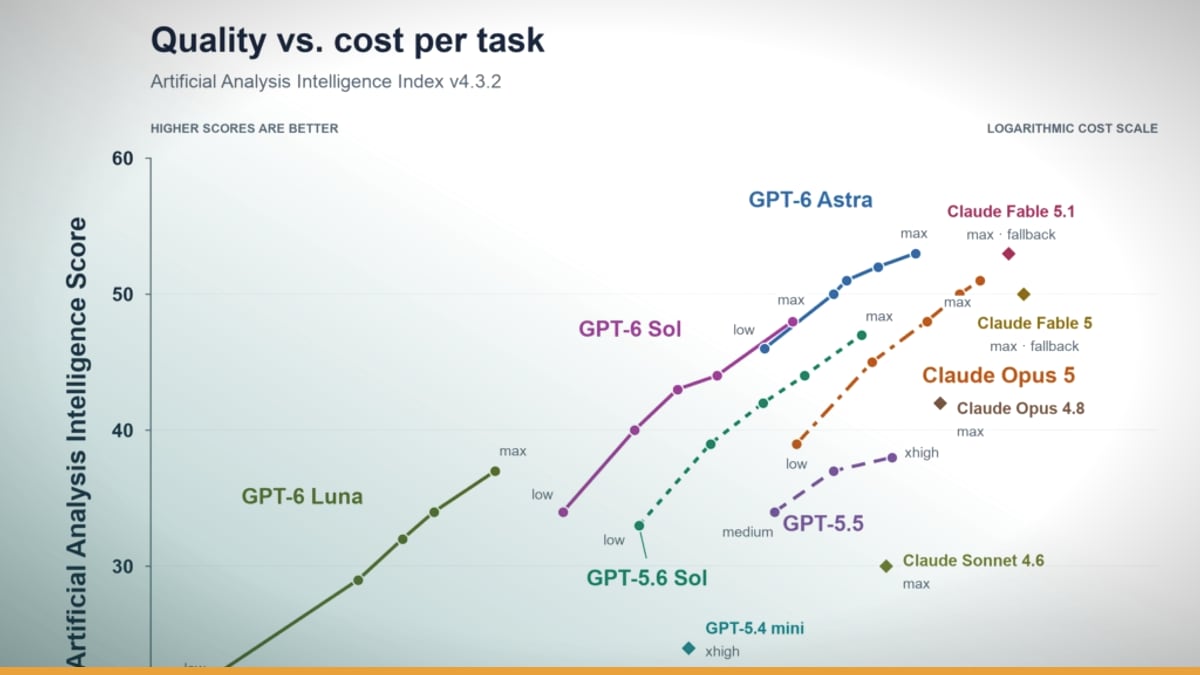
Header image source: GPT-6 Astra, Sol, and Luna for production AI agents in Microsoft Foundry | Microsoft Azure Blog via Microsoft Azure via Google — cropped to 16:9 and colour-adjusted.
Key takeaways
- GPT-6 Sol costs $2/million tokens for coding tasks, 80% cheaper than Claude Opus 5
- Luna handles document work for $0.07 per task, 10x cheaper than GPT-5.6 Sol
- Both models sacrifice versatility for cost efficiency and specialized performance
September 22, 2026. OpenAI dropped GPT-6 Sol and Luna. Two models. Two lanes. Sol for coding and analytics. Luna for document work—summaries, extraction, the grunt work of digital offices. Both cost 50–60% less than GPT-5.6. That’s not a discount. That’s a restructuring.
$2 per million input tokens for Sol. $10 for output. Luna? $0.10 in, $0.50 out. For context, GPT-5.6 Sol maxed at $1.99 per task on the Artificial Analysis Intelligence Index. GPT-6 Sol does it for $1.06. Luna plunges from $0.18 to $0.07. These aren’t price cuts. They’re a declaration: OpenAI is splitting its lineup into cost tiers.
How OpenAI Halved Prices Without Halving Brains
Caching. Inference optimizations. The brief doesn’t spell out the magic, but the results don’t need explaining. Luna matches GPT-5.6 Sol’s performance at one-hundredth the cost when both run at higher effort. One-hundredth. That’s not efficiency. That’s a loophole in the economics of AI.
But is this real progress, or just better plumbing? GPT-4.0 squeezed more from less. GPT-5.0 squeezed harder. Sol and Luna might just be the next turn of the screw—more performance per watt, not a new engine. If that’s the case, the cost drops are still impressive. They’re just not revolutionary. They’re what happens when you iterate long enough.
Where Sol and Luna Actually Get Better
Sol’s Coding Agent Index score: 57. Up two points from GPT-5.6 Sol. Not a revolution, but a steady climb. Terminal-Bench 4.0 jumps from 37% to 43%. SWE-Atlas-QnA from 54% to 58%. Small numbers. Big impact. Sol hits 60.5% on OSWorld 2.0, tying Claude Opus 5 (60.3%) while costing 80% less. That’s not just cheaper. That’s a different class of value.
Luna doesn’t care about coding. Its Coding Agent Index drops to 41, down 2 points from its predecessor. But for clerical work? It’s a monster. At medium effort, it beats GPT-5.6 Sol at a tenth of the cost. Document summarization, information extraction—Luna is built for volume. The question isn’t whether it’s better. It’s whether users will tolerate its weaknesses elsewhere.
The Trade-Offs: What You Lose When You Win on Price
Specialization has costs. Luna’s SWE-Atlas-QnA score drops from 49% to 44%. DeepSWE v1.1 from 66% to 64%. Not catastrophic. But noticeable. The GDPval-AA v2.1 benchmark—44 occupations, economically valuable tasks—shows Sol down 100 Elo points. Luna down 75. These models are sharper in their lanes but blunter everywhere else.
Factual errors are the real sticking point. Sol’s error rate improves to 4.5%, down from ~9%. Luna’s to 7.6%, down from ~9%. Better. Not fixed. OpenAI’s internal evals show Sol’s hallucination rate at 60% (down from 92%). Luna’s factual error rate is 7.6%. Those numbers are progress. They’re not trust.
Accessibility is the last trade-off. Sol and Luna are API-only. No ChatGPT interface. That’s a deliberate snub to casual users. OpenAI is segmenting its market: cheap, specialized models for developers and enterprises. Everyone else pays more or gets less.
Astra’s Shadow: Alignment as a Cost-Saving Trick
Sol and Luna build on GPT-6 Astra’s alignment work. OpenAI calls Astra its "most aligned model to date. " Alignment here likely means fewer hallucinations, cleaner outputs, tighter instruction-following. The numbers back it up: Sol’s hallucination rate drops from 92% to 60%. Luna’s from 93% to 77%.
But here’s the twist: alignment might be a cost lever. Cleaner outputs mean fewer recomputes, less human oversight. If alignment reduces post-processing, it could indirectly lower costs. That’s speculative. But it fits. Sol and Luna are both cheaper and more reliable than their predecessors. Coincidence?
Benchmarking the Competition: Cheaper Doesn’t Mean Weaker
Sol’s OSWorld 2.0 score—60.5%—ties Claude Opus 5 (60.3%) while costing 80% less. That’s a direct challenge to Anthropic’s premium pricing. Luna’s $0. Luna’s $0.07 per task for clerical work represents a significant price advantage.50 or more. The brief doesn’t provide direct comparisons, but the pricing tells the story.
Are Sol and Luna truly competitive? Claude Opus and Gemini Ultra are still the gold standards for raw power. Sol and Luna trade versatility for cost efficiency. For users who don’t need the absolute best, they’re compelling. For those who do, the trade-offs might sting.
Who Wins, Who Loses
Startups and enterprises scaling clerical work will love Luna’s $0.07 per task pricing. Developers needing cheaper coding help will appreciate Sol’s $1.06 per task. The pricing is aggressive enough to make AI viable for applications that were previously too expensive.
But there are losers. Users who need zero-error outputs will find Sol and Luna’s factuality gaps frustrating. Non-API users are locked out entirely. Competitors like Anthropic and Mistral may struggle to justify their higher prices if Sol and Luna deliver comparable performance at a fraction of the cost.
The bigger effect could be accelerated AI adoption in cost-sensitive industries. Healthcare, legal, financial services have been slow to adopt AI due to high costs and reliability concerns. Sol and Luna fix the cost issue. The reliability gaps remain. If OpenAI closes those, these industries could see a surge in AI integration.
What’s Next for Sol and Luna?
No multimodal support. No ChatGPT interface. These models are enterprise-focused, API-only tools. That’s a deliberate choice. But it raises questions. Will OpenAI close the factuality gap in future updates? Can Luna’s clerical edge extend to more complex tasks? Right now, neither model is a generalist.
The most interesting question is whether Sol and Luna will become a permanent "budget tier. " OpenAI’s lineup now includes Astra (premium flagship), Sol and Luna (task-specific, cost-efficient), and older models like GPT-4.0 (legacy). That segmentation makes sense. But it also creates fragmentation. Will OpenAI eventually merge Sol and Luna into Astra’s capabilities, or will they remain distinct?
If pricing stays this low, competitors may be forced to follow. Anthropic and Mistral can’t ignore Sol and Luna’s cost advantages forever. The risk for OpenAI is a race to the bottom, where cost efficiency overshadows innovation. But for now, Sol and Luna are setting a new standard.
The Big Picture: Efficiency Over Everything
Sol and Luna mark a shift. For years, AI progress meant bigger models, more parameters, higher benchmarks. Sol and Luna prioritize cost efficiency and task-specific optimization. That’s not a bad thing. It’s a response to reality: not every user needs the absolute best. Sometimes, good enough at a lower cost is the better choice.
But it’s also a reminder that AI progress isn’t linear. GPT-3.5 was the first "budget" model. GPT-4.0 pushed boundaries. GPT-6 Astra became the premium flagship. Sol and Luna represent the next phase: task-specific, cost-optimized models that deliver value without breaking the bank.
The question is whether this is the future. Will we see a proliferation of specialized models, each optimized for a narrow use case? Or is this a temporary workaround until compute becomes cheap enough to make general-purpose models affordable for everyone? Sol and Luna suggest the future might be more fragmented than we thought.
The challenge for OpenAI—and its competitors—will be balancing cost efficiency with versatility. For now, Sol and Luna prove that AI progress isn’t just about bigger models. It’s about smarter deployment. The question is whether users will accept the trade-offs. Or will they demand both—cheap and capable?
Sources
- OpenAI launches GPT-6 Sol and Luna, boasting lower cost and fewer mistakes
- GPT-6 Sol and Luna push the cost-efficiency frontier
- OpenAI rolls out GPT-6 Sol and Luna with up to 50% lower API pricing
- OpenAI Rolls Out Cheaper GPT-6 Sol & Luna Models, Days After Flagship Astra Debut
- GPT-6 Sol and Luna Arrive at Half Price—How to Choose an AI Model to Stop Worrying About High Costs