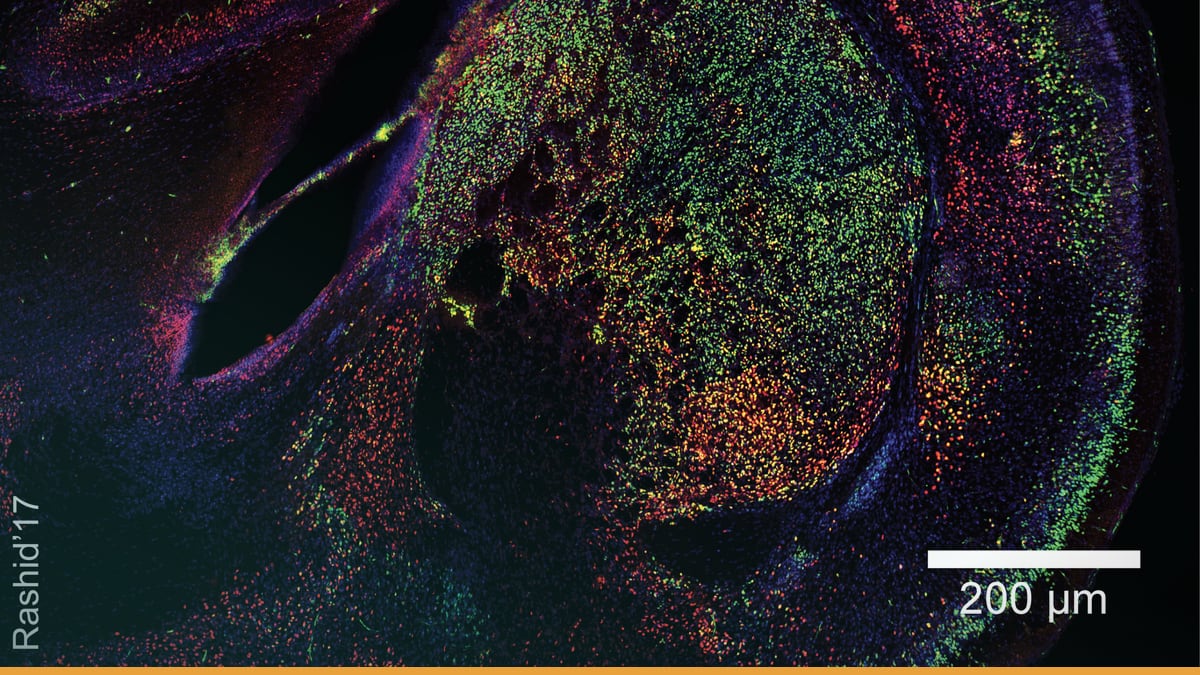
Header image: Brain Cortex by Mamunur Rashid, CC BY 4.0, via Wikimedia Commons — cropped to 16:9 and colour-adjusted.
Key takeaways
- 50% of a mouse’s cortex/hippocampus replaced with human cells
- Behavioral readout limited to basic movement tracking
- Ethical debates intensify over species limits and functional integration
Nearly half of a living mouse’s brain is now human cells. Not just scattered clusters—entire swathes of its cortex and hippocampus have been replaced with human cells. The mice move. They explore an arena. Their trajectories appear as Pong-like traces on a monitor, their speed and position logged by cameras. That, more than anything, is what unsettles.
This isn’t speculative. The question isn’t whether it’s technically impressive—it is—but whether the scientific payoff justifies the biological and ethical tightrope the field is now walking.
The Experiment: A Mouse Brain Rebuilt, Cell by Human Cell
The scale here is staggering. This work obliterates those limits: nearly 50% of the brain’s volume is now human, specifically targeting the cortex and hippocampus. Moved.
Timing is everything.
What’s missing is proof that the human cells are functionally integrated. The behavioral readout is crude: mice wandering in an arena, their paths rendered as Pong-like traces. Speed. Position. Trajectory. The experiment is a structural triumph.
Why Target the Cortex and Hippocampus? The High-Stakes Brain Regions
The cortex and hippocampus weren’t chosen lightly.
The technical challenge is immense.
The Behavioral Readout: What the Mouse’s Movements Tell Us (and What They Don’t)
The mice move. They explore. Their paths are logged as Pong-like traces on a monitor. But let’s be clear: this is a minimal behavioral readout. It’s like checking if a car starts without bothering to see if the engine is actually running.
For that, we’d need more sophisticated testing. The brief doesn’t mention any of these, which is a glaring omission.
There’s also the question of what "normal" behavior even means in this context. A mouse with half its cortex and hippocampus replaced by human cells isn’t a wild-type mouse. Without functional data, we’re left guessing.
The Technical Breakthrough: How They Did It (and Why It Matters)
The real breakthrough here isn’t the mouse’s behavior.
Timing is critical.
The next frontier is functional validation. The brief doesn’t answer these questions, but future experiments will need to.
The Evolutionary Gap: Why a Mouse Brain Is a Poor Stand-In for a Human One
More importantly, the evolutionary distance between mice and humans is vast.
There’s also the question of developmental timing.
This evolutionary gap is both a limitation and a safeguard. But the gap also means we shouldn’t overinterpret the results. A mouse with half a human brain is still a mouse, not a half-human hybrid.
The Criticism: Where the Experiment Crosses an Ethical Line
Sergiu Pașca, a Stanford neuroscientist, has cautioned against adding human brain organoids to a monkey engineered to lack a cortex.
The key distinction, for now, is species. If 50% is acceptable in mice, what’s the upper limit? 60%? 80%? And does the species matter more than the percentage?
But is the scientific payoff proportional to the ethical risk?
The slippery slope argument is unavoidable. If this work is acceptable, what’s next? Higher-order chimeras in primates? Human cells in regions beyond the cortex and hippocampus?
The Scientific Payoff: What This Means for Disease Modeling
The potential applications are significant.
There’s also the potential for drug testing.
The catch is whether the human cells are truly integrated into the mouse’s neural circuits. If they’re just passive occupants of space, the model’s utility is limited. The brief doesn’t confirm whether human cells formed synapses with mouse neurons, so it’s unclear whether the chimeric brains are functionally chimeric or merely structurally so.
The Road Ahead: What’s Next for Human-Mouse Brain Chimeras?
The immediate next steps are clear: functional validation.
Behavioral testing will also need to become more sophisticated. Simple locomotion metrics won’t cut it.
The bigger question is whether this technique will eventually be applied to non-human primates. The brief mentions Pașca’s warning about monkeys. If that happens, the ethical debates will become even more fraught. Where does the field draw the line? Is it the percentage of human cells, the species involved, or the brain regions targeted?
Regulatory scrutiny is also likely to increase.
The Big Question: What Does This Say About the Future of Brain Engineering?
It also highlights how little we know about cross-species neural compatibility. Moved. But we have no idea whether their human cells were functionally integrated into their neural circuits. The structural achievement is undeniable. The functional implications remain unclear.
The ethical implications are equally uncertain. The more human a chimeric brain becomes, the harder it is to justify the research. Where’s the inflection point? Is it when the percentage of human cells crosses a certain threshold? When the species involved is a primate? When the brain regions targeted are associated with higher-order cognition?
The philosophical implications are perhaps the most intriguing. If a mouse with half a human brain behaves no differently, does that mean human neural identity is more about organization than origin? Or is the experiment still too crude to detect subtle changes? The brief doesn’t answer these questions. But they’re the ones that will define the future of chimeric research.
This isn’t about creating a "human mouse. " It’s about pushing the limits of what chimeric brains can teach us—before we’re forced to confront the ethical limits of what they should. The real breakthrough isn’t the mouse’s behavior. It’s the technical feat of integrating human cells at scale. And the questions it raises about the boundaries of interspecies brain engineering. The next frontier isn’t just about what we can do. It’s about what we should.