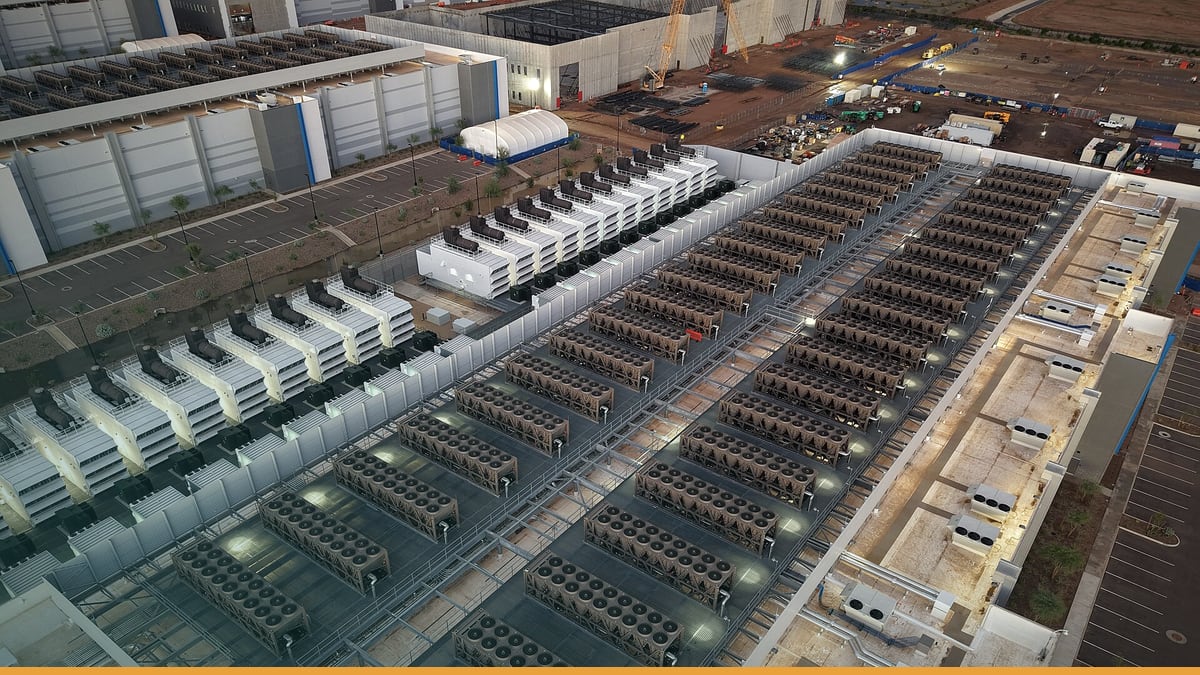
Header image: Data center roof by Rsparks3, CC0, via Wikimedia Commons — cropped to 16:9 and colour-adjusted.
Key takeaways
- Crusoe raises $3.9B at $30.9B valuation to build modular AI factories
- Spark units are truck-deployable data centers that bypass construction bottlenecks
- Jane Street’s $13B deal shows AI infrastructure as a service model
Crusoe just raised $3.9 billion at a $30.9 billion valuation. That’s not growth. That’s a valuation detonation. Ten months ago, they were at $10 billion. But debt and equity aren’t the same game. This round isn’t just capital. It’s a wager that truck-deployable AI factories can outrun hyperscale.
The Valuation Rocket: $10B to $30.9B in Ten Months
October 2025: Crusoe raises $1.38 billion at a $10 billion valuation. Today: $30.9 billion. That’s not scaling. That’s a valuation supernova. The round was led by Atreides Management, Mubadala Capital, and Valor Equity Partners. These aren’t your usual growth-stage tourists. This capital doesn’t chase trends. It backs companies that redraw industries.
Is this confidence in Crusoe’s model or just AI infrastructure’s latest valuation bubble? Both. But the size of this round suggests something sharper than a cash grab. Crusoe isn’t just building data centers. It’s betting that modular, truck-deployable units can solve AI’s biggest bottlenecks: speed, locality, and NIMBY backlash.
The OpenAI Paradox: Hyperscale as Credibility, Not Profit
OpenAI uses Crusoe’s Abilene, Texas data center. That’s a stamp of approval. It’s also a sign of how the industry works. Hyperscale centers are anchor tenants—they lend credibility, but they’re not the profit engines. Crusoe’s revenue streams tell a different story: leasing space, renting GPUs, selling inference compute.
The real margin driver? Inference-as-a-service. Crusoe’s $13 billion, five-year contract with Jane Street—a quantitative trading firm—proves it. It’s outsourcing GPU infrastructure to Crusoe. That’s a template for how enterprises might handle AI infrastructure: rent, don’t own. Crusoe isn’t just competing.
But here’s the rub: Are hyperscale centers even profitable? OpenAI’s use of Abilene suggests hyperscale centers provide credibility. The Jane Street deal involves inference compute. If that’s true, Crusoe’s dual strategy—hyperscale for training, modular for inference—starts to look less like indecision and more like a hedge against an uncertain future.
Spark: The Modular Moonshot
Crusoe’s modular AI factories, called Spark, are manufactured in-house and deployable by truck. No construction crews. Just plug them into a large power source and you’ve got a data center.
This isn’t entirely new. But Crusoe’s approach is different. The idea is to bypass the bottlenecks of traditional data center construction. If Spark units can be deployed quickly, Crusoe gains an agility advantage.
But modularity has tradeoffs. Modularity has constraints. But for inference workloads, it could be suitable. The question is whether modular can scale beyond niche use cases. If Crusoe can prove Spark units handle enterprise-grade AI workloads, it could redefine how data centers are built.
The NIMBY Workaround
Spark’s biggest advantage might be sidestepping the backlash against massive data center complexes. The issue isn’t just size.
Crusoe’s modular approach could change that. Smaller footprints could reduce impact. But modular data centers come with risks. Will communities accept modular units if they’re still drawing massive power? But it’s not a silver bullet.
The real test: Can modular centers avoid the regulatory backlash slowing hyperscale projects? If they can, Crusoe gains a significant advantage. If not, the NIMBY problem just shifts from large complexes to smaller, more numerous units.
Jane Street’s $13B Contract: A Blueprint for AI Infrastructure as a Service
Crusoe’s $13 billion deal with Jane Street isn’t just a contract. It’s a blueprint. The five-year agreement to supply GPUs and AI infrastructure provides GPU-as-a-service.
It’s not just renting GPUs. It’s providing the entire infrastructure. That’s compelling for enterprises that don’t want to manage data centers but still need high-performance AI infrastructure.
The question: Does this model scale beyond financial services? Jane Street is a quant trading firm. If Crusoe can prove its GPU-as-a-service model works for a broader range of enterprises, it could disrupt the entire AI infrastructure market.
The Power Paradox: Can Modular Centers Scale Without Grid Collapse?
Spark units need large power sources. Crusoe’s modular approach has implications for power grids.
Modular units could be deployed near power sources. But deploying many Spark units could strain local grids.
The real challenge isn’t just power. It’s predictability. Modular units might face power challenges. If Crusoe can’t guarantee stable power for Spark units, the modular advantage evaporates.
The Open Question: Will Spark Units Become the New Standard?
Crusoe’s $3.9 billion war chest will accelerate both hyperscale and modular deployments. The question isn’t whether the dual strategy is a hedge or indecision. Modular units could handle inference workloads.
Regulatory risks loom.
The most interesting question isn’t whether modular data centers will work. It’s whether they’ll redefine the entire industry. If Spark units solve speed, locality, and NIMBY problems, Crusoe won’t just be a data center company. And that’s a bet worth $3.9 billion.