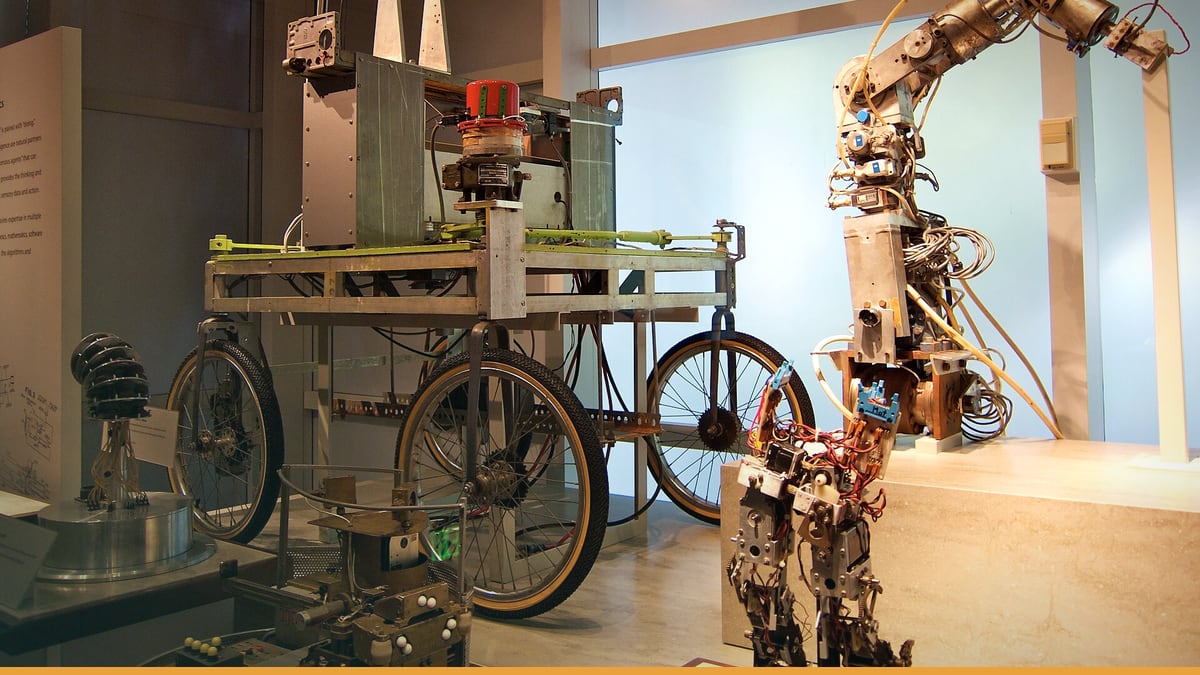
Header image: Stanford Cart and Hydraulic Arm (5900601910).jpg) by Don DeBold from San Jose, CA, USA, CC BY 2.0, via Wikimedia Commons — cropped to 16:9 and colour-adjusted.
Key takeaways
- Current robot safety frameworks fail in unpredictable real-world environments
- AI robots are vulnerable to stealthy perception-based attacks that leave no traces
- New approaches must bake security into training data and runtime behavior, not treat it as an afterthought
Research has demonstrated this. Cyberattacks can manipulate a robot’s behavior by altering its perception—what it sees, hears, or interprets—without requiring direct control. And as robots grow more complex, operating alongside humans in unstructured environments, the gaps in security keep widening.
The Real Weakness Isn’t Code—It’s What the Robot Believes
Such manipulation can occur anywhere across a robot’s complex sensing and decision-making system.
The worst part?
Predictable Safety Doesn’t Work in the Real World
Movements must be deterministic—pre-programmed and repeatable—so humans can anticipate what the robot will do. This works for industrial arms in controlled environments. For AI-driven robots operating in the real world? It’s a dead end.
Real-world environments are messy. Noisy. Unpredictable. Deterministic safety frameworks can’t handle that. They force a trade-off: either limit the robot’s capabilities to fit within rigid constraints, or accept that it will fail in edge cases.
The more adaptable the robot, the harder it is to guarantee safety. And the harder it is to guarantee safety, the less useful the robot becomes.
Scanning, Simulating, Monitoring: A Start, Not a Solution
VicOne, a cybersecurity firm specializing in "Physical AI," proposes a multi-layered approach to close these gaps.
- AI model and vulnerability scanning: Before a robot deploys, its neural networks are scanned for weaknesses—backdoors, adversarial vulnerabilities, biases in training data. The goal is to catch exploits before they’re deployed.
- Simulation-based validation: Robots are tested in virtual environments against adversarial scenarios.
- Continuous runtime monitoring: Even after deployment, robots are monitored for anomalies.
This is a step forward. It’s not a silver bullet.
First, it’s reactive. Scanning and simulation catch known threats, but they’re less effective against novel attacks. Continuous monitoring is only as good as the baseline of "normal" behavior—hard to define for robots in dynamic environments.
Scalability is another problem. How do you ensure continuous monitoring for a system that might outlive its original security protocols? What about robots that receive frequent updates? Every new model or software version introduces fresh attack surfaces.
The Explainability Trap: Can We Trust What We Don’t Understand?
Explainability is framed as a "first step" toward safe AI-driven robots. If we understand a robot’s decision-making, the thinking goes, we can align it with ethical and moral codes. But explainability is a slippery concept.
They’re imperfect. In high-stakes scenarios, like a robot operating near humans, "good enough" explanations aren’t sufficient.
The deeper issue? Explainability doesn’t equal safety. A robot might explain why it took an action, but that doesn’t mean the action was correct—or that it won’t do something unpredictable next time. Explainability is a band-aid. It doesn’t resolve the fundamental tension between AI’s adaptability and the need for predictable, verifiable behavior.
Safety vs. Utility: The Uncomfortable Trade-Off
Ensuring worker safety often means limiting a robot’s capabilities. This isn’t just technical—it’s economic. Overly cautious robots may fail to justify their cost. Risky ones invite accidents.
The more freedom you give a robot to adapt, the harder it is to guarantee it won’t harm a worker. But lock it down with rigid protocols, and it becomes little more than a slow, expensive tool.
The criticism that collaborative robots’ safety can be compromised in "noisy, real-world environments" isn’t just technical. It’s a warning. Current safety approaches are built on assumptions that don’t hold up in the age of AI.
Three Open Questions
- How do we secure robots that evolve post-deployment?
Security can’t be a one-time check. It needs to evolve alongside the robot. But how?
- Who’s liable when a robot fails due to an AI-specific attack?
If a robot’s behavior is manipulated through adversarial inputs, who’s responsible? The manufacturer? The AI model developer? The deploying company? Without clear rules, companies have little incentive to invest in robust security.
- Can simulation ever fully replace real-world testing?
Simulation is touted as a way to test robots against adversarial scenarios without real-world risk. But simulations are only as good as their data. Can a simulated environment ever replicate the chaos of the real world? Or will physical testing always be necessary?
The Hard Truth
They’re vulnerable to perception-based attacks—stealthy exploits that alter behavior without leaving traces. Current safety frameworks, built for mechanical reliability and predictable movements, are ill-equipped for these threats.
The tools exist—model scanning, simulation, continuous monitoring—but they’re not enough. What’s needed is a shift in mindset. Safety can’t be an afterthought. It needs to be baked into every layer, from training data to runtime behavior. And it needs to account for the fact that robots, like humans, will make mistakes—especially when their perception is under attack.
The question isn’t whether we can make AI-powered robots safe. It’s whether we’re willing to accept the trade-offs required.